
Collaboration. Serendipity. Diversity. These are the qualities that come to mind when I think about this year’s OCLC quilt and the community that created it.
The OCLC Quilters, a group of current and retired OCLC employees, have spent months creating a quilt of 120 cross-cut blocks to donate to the silent auction held during the ALA 2026 Annual Conference. The ALA BiblioQuilters annually host this auction as a fundraiser for the Christopher Hoy Scholarship, which awards a $5,000 scholarship each year to a U.S./Canadian citizen or permanent resident who is pursuing an MLS in an ALA-accredited program.
This is the fourth year in a row that the OCLC Quilters have donated a quilt to the silent auction. Their work inspired me to take up sewing about a year ago, and I’m proud to move from admirer to participant, contributing to the OCLC quilt for the first time. Although left-handed people are about 10% of the population, three of the 13 people contributing to the OCLC quilt, including myself, are left-handed. While that doesn’t affect the result, it requires a few adjustments in technique and having the appropriate scissors. Sharing advice on adapting equipment and shopping for left-handed supplies is one of the ways we support each other.
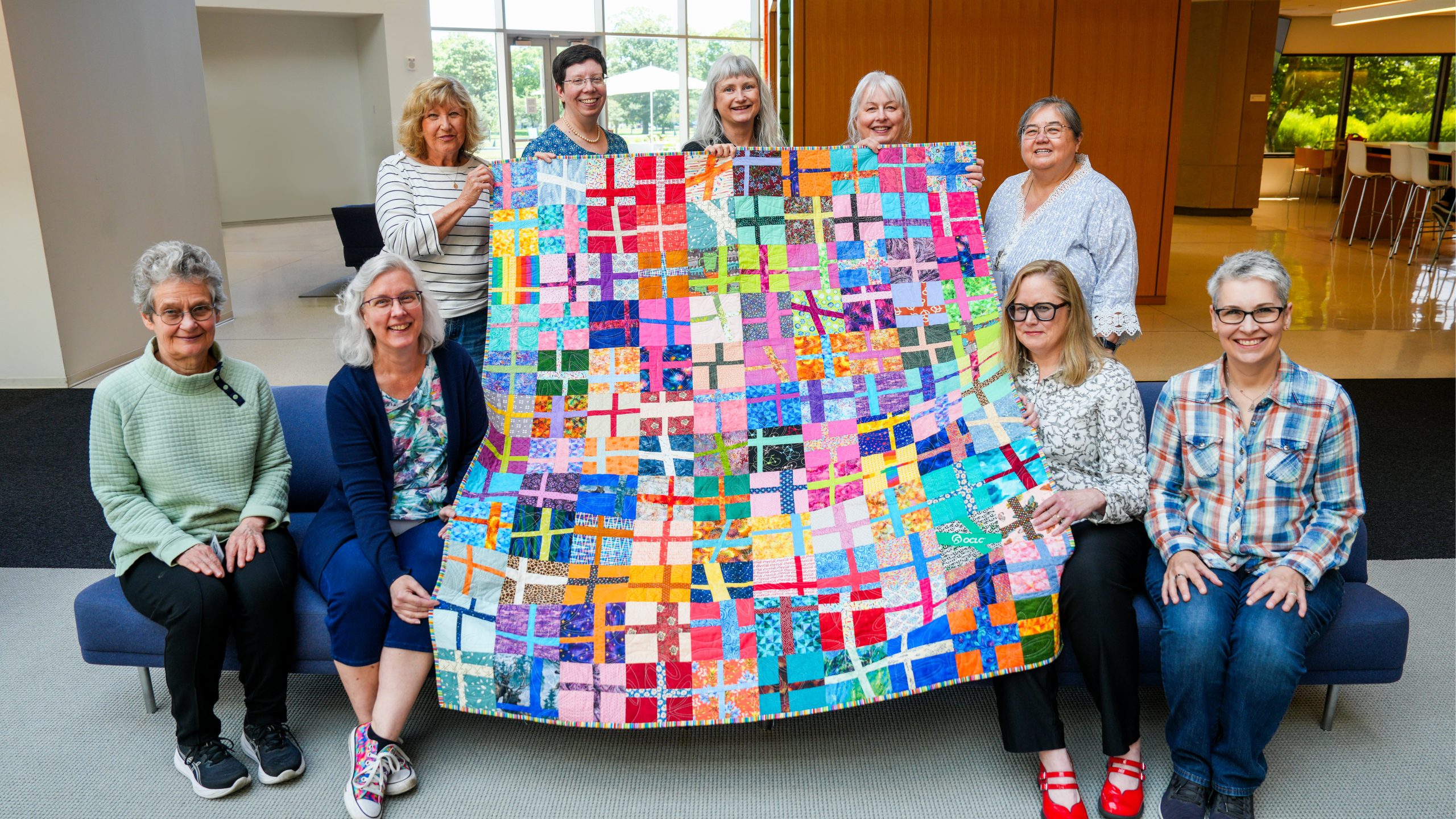
Like all handicrafts, quilting is an activity with its own nomenclature. As a quilter and cataloger, I found myself wondering: “What controlled vocabulary terms could I use to describe the OCLC quilt?” There are several from vocabularies such as Library of Congress Subject Headings (LCSH) and Getty Art and Architecture Thesaurus (AAT). These are listed at the end of this blog.
A quilt is created from many elements that may not be individually significant but form a meaningful whole, just like a WorldCat bibliographic record. The blocks of the quilt function like data elements in a WorldCat record, with contributions from multiple individuals creating the larger work.
Assembling the quilt
OCLC quilters sewed 120 blocks, which are the fabric squares comprising the quilt’s front. The blocks are a cross-cut design—a pattern chosen because it is accessible for novice sewists and makes good use of small fabric pieces. Quilters often save these leftover pieces, called “scraps,” from other projects for future use. Reusing scraps makes quilting a sustainable craft, and quilters often share them with one another. An experienced OCLC quilter, who keeps her scrap collection organized in true librarian fashion, donated most of the fabric pieces used for the blocks.
Experienced quilters arranged and sewed the blocks together and cut the batting (soft material used between the front and back sides of the quilt). The next step, in which three layers are sewn together with a decorative stitch, is quilting. This is the strict definition of the term “quilting,” although it is often used to refer to the entire process of creating a quilt. The pattern used for the quilt stitching is called “modern ties,” and it looks a bit like tied shoelace loops.
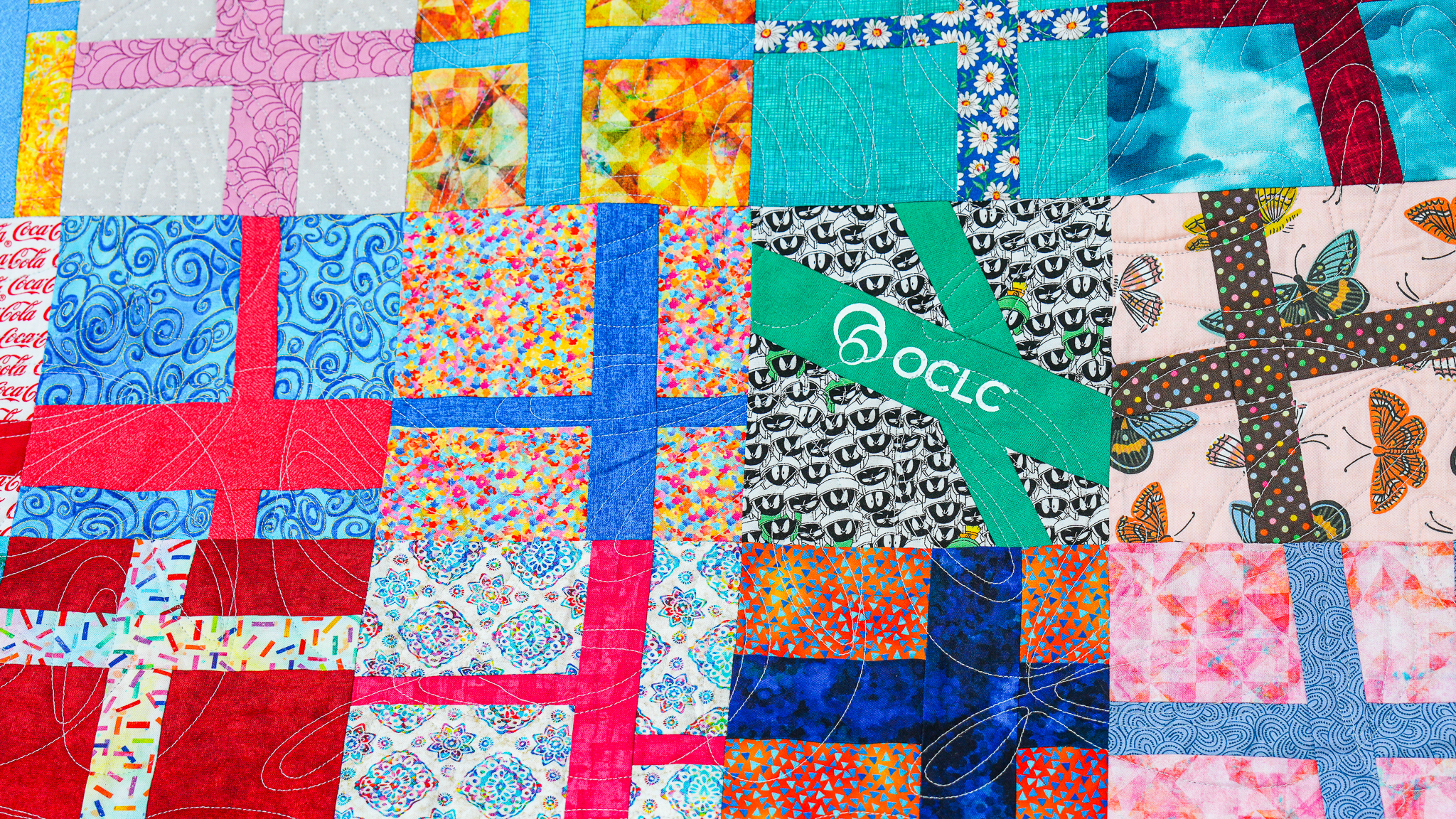
The final step is to sew a long strip of binding fabric around the edges of the quilt, which will keep the ends from fraying as well as being decorative. Two labels were sewn into the binding: “Made in OH” and “Is it perfect? No.” Both of these labels are accurate descriptions of this quilt, but unlike in bibliographic descriptions, a certain amount of imperfection is not only tolerated but may be considered part of the quilt’s charm.
A quilting tradition at ALA Annual
The OCLC quilt will be one of many available at the ALA BiblioQuilters silent auction during ALA Annual in Chicago, Illinois. The BiblioQuilters were founded at the 1998 ALA Annual Conference in Washington, D.C. Since 2000, the BiblioQuilters have had a silent auction of quilts every year except 2020 and 2021 (because of the pandemic). The quilts are usually available to view and bid on near the registration area. If you are attending ALA in Chicago, I highly recommend you visit the auction table to view them. After ALA, you may be inspired to browse the shelves of your local public library for 746.46, the Dewey Decimal number for quilting.
Subject vocabulary terms
For those readers who appreciate quilting and metadata, the following controlled vocabulary terms reflect concepts discussed in this blog. You might even find it fun to match the concepts to the natural language descriptions!
Getty Art and Architecture Thesaurus terms
Library of Congress Subject Heading terms
The post 120 blocks, one story: The collective creation of the OCLC Quilt appeared first on Hanging Together.

Comments (0)